Category: GERD & Digestive Health
From night-time fullness to recovery: a hopeful path for GERD and peptic ulcer care
ไทย · English
· ☕ Buy me a coffee
Epigastric fullness and
GERD
often improve when you care for the stomach and bowel regularity together,
rebuild habits systematically, and use medicines or herbs only under clinical guidance.
Recovery takes months — not a single week — but the path is clear and doable.
Red flags — seek care now
- Severe chest pain, shortness of breath, or fainting
- Vomiting blood, black stools, or unexplained weight loss
- Food sticking on swallow, persistent vomiting, or inability to eat
Go to a clinician or emergency care immediately.
If these symptoms are exhausting you — you are not alone
Fullness that pushes pressure into the head, throat burn when you lie flat,
waking at night with sour belching, then morning anxiety about “when will this end” —
that weariness is real. It is not only the body; every meal starts to feel like a risk.
This article is not a cold textbook.
It is a lived recovery journey for GERD and peptic ulcer,
shaped with nutrition and traditional-medicine guidance, then organized into steps you can follow.
Compiled by
Asst. Prof. Dr. Norawit Raatpiboon
alongside evidence from
NIDDK
and PubMed.
but with the right system many people feel lighter in the middle phase —
and closer to normal life later.
What matters most is small, continuous discipline, not one perfect day.
Why digestion and elimination must be fixed together
One clinician line that sticks:
“The gut is a pipe — if the outlet is blocked, the top cannot clear.”
In plain terms: poor bowel clearance leaves waste and gas, raises abdominal pressure,
and that pressure can push back toward the stomach and esophagus.
That is why daily mucosal protectants alone may still leave fullness —
the downstream cause was never addressed.
Upper
Stomach / esophagus — burning, sour belch, fullness
Middle
Digestion and transit — too slow or too fast both matter
Lower
Bowel / elimination — if stuck, gas pushes upward easily
This recovery plan is not only “lower the acid.” It also coats mucosa,
eases trapped gas, and supports safer fiber-assisted elimination.
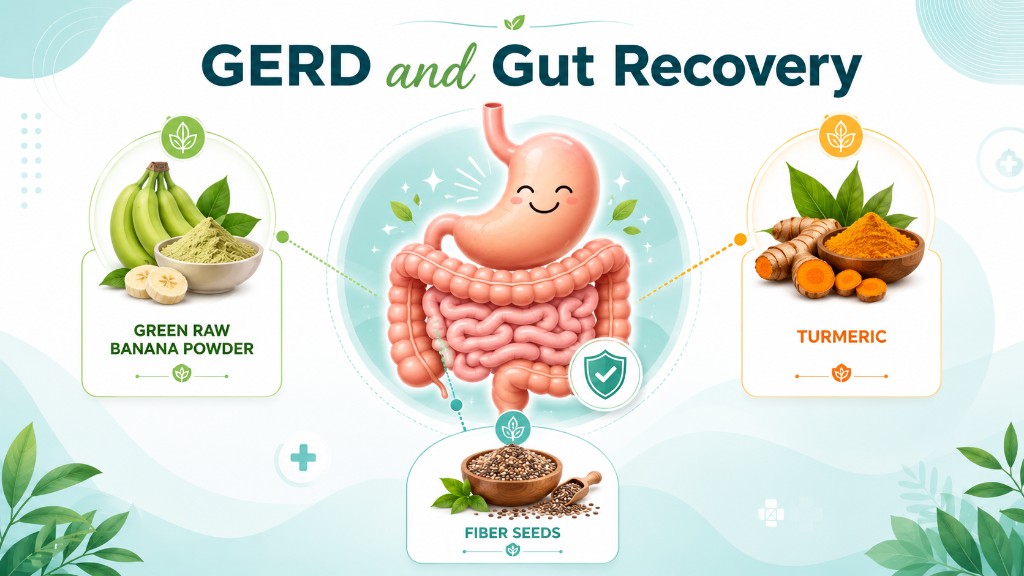
Natural herb and fiber helpers used as adjuncts
This is a “toolkit” used alongside clinician advice — not a substitute for ulcer treatment
or testing for
H. pylori
when suspected.
| Helper | Typical use (summary) | Main role | Cautions |
|---|---|---|---|
| Green (unripe) banana powder | 2 tsp + warm water · morning / midday / before bed | Supports mucosal coating (resistant-starch pathway) | Choose a clean source; banana allergy or kidney disease — ask a clinician first |
| Curcumin (turmeric) capsule | After meals, per clinician or label dose | May ease gas-related bloating for some people | Caution with anticoagulants / gallstones — ask a clinician |
| Fiber (psyllium husk / basil seed) | Mix as directed + generous water chase | Supports bowel regularity so the “outlet” flows | Low fluid is risky; do not self-use with bowel obstruction |
Add one item at a time, watch symptoms 2–3 days, then increase —
an inflamed gut prefers gentleness over heroics.
Want to know how severe your symptoms are right now?
Analyze your severity level and get personalized guidance from our Advisory team
Six habit shifts that change the trajectory
Herbs help, but if daily triggers stay on, it is like pouring water into a leaky bucket.
Pause fatty, fried, spicy foods, coffee, and alcohol
Classic GERD triggers — especially while mucosa is still reactive.
Reduce heavy red meats; favor easier proteins such as fish
Large slow-digesting meals linger → night-time belching rises.
Eat and sleep on a schedule (at least 3 hours before bed)
A pre-sleep gap clearly lowers nocturnal reflux risk for many people.
Downshift stress — brief meditation / slow breathing
Stress does not always “make more acid,” but it amplifies symptom perception and worsens eating habits.
Walk 10–15 minutes after meals
No sprint needed — a gentle post-meal walk often eases heaviness.
Pause intermittent fasting while the stomach is inflamed
Long fasts on an unready mucosa can irritate more — resume when stable and a clinician agrees.
The patience path: a 9-month timeline
Many people quit after two weeks of “still not cured.”
In this journey, symptoms do not flip overnight — they change in layers.
Months 1–3: adaptation
- The body is leaving old triggers and building new discipline
- Symptoms may still fluctuate — expected in this phase
- Goal: make the 6-habit checklist automatic — not 100% symptom-free yet
Months 4–5: symptoms lighten
- Less fullness; longer stretches of sleep on many nights
- You learn which foods and habits are your personal weak spots
- Goal: keep discipline + discuss medicine taper with your clinician if relevant
Months 6–9: nearer to normal life
- More flexibility within a safe frame
- Faster recovery when occasional flares return
- Goal: keep core habits — do not return to “eat anything and hope”
One off meal is not a ruined year — re-enter the path at the next meal.
Care comparison: medicines · herbs/fiber · lifestyle
| Approach | Examples | Strengths | Limits |
|---|---|---|---|
| Clinician-directed drug classes | Antacids, alginate raft-formers, H2-receptor antagonists, PPIs, sucralfate — by indication | Clear acid reduction / mucosal protection in acute phases | Need correct dose and duration; do not replace long-term habit change |
| Herbs / natural fiber | Green banana powder, curcumin, psyllium / basil seed | May support coating, gas comfort, and elimination | Product quality varies; contraindications with some diseases/medicines |
| Lifestyle redesign | Avoid triggers, 3-hour pre-bed gap, post-meal walk, stress skills | Long-term base; lowers relapse risk | Needs time and consistency — not a 2–3 day fix |
Simple mechanism: why this plan is coherent
From clinical guidelines and research summaries,
GERD
involves the lower esophageal sphincter (LES), esophageal acid clearance,
and reflux-promoting factors such as late meals, fatty/fried foods, and lying flat after eating.
- Coat / protect mucosa: during ulceration or inflammation, the goal is fewer repeat insults — from prescribed therapy and, in some studies, resistant starch from green banana.
- Reduce gas and pressure: excess gut gas → fullness and upward push; slow eating, less frying, and gas-easing adjuncts fit that logic.
- Water-binding fiber: psyllium can help constipation when fluid intake is adequate, easing lower-gut pressure.
Mechanism summary by
Asst. Prof. Dr. Norawit Raatpiboon,
synthesized from
NIH/NIDDK
and PubMed (curcumin, psyllium, green banana / resistant starch).
Frequently asked questions (FAQ)
Can I use acid-reducing medicines together with herbs and fiber?
Yes — follow what your clinician prescribed first, then taper only when symptoms are stable.
Do not abruptly stop acid-suppressing drug classes without advice;
some people get rebound symptoms.
Can GERD come back?
It can, if old trigger habits return at full force.
The good news: people who recover with a structured plan usually cope better —
they know their weak spots and already have a checklist to re-enter the path.
Why does treating only the stomach never seem to finish the job?
Because the digestive tract is continuous. Poor elimination leaves gas and waste below,
so pressure pushes upward easily. Digestion and bowel regularity both matter.
How often should I take green banana powder?
The experiential routine shared here is 2 teaspoons in warm water
morning / midday / before bed — adjust to tolerance and your clinician’s advice.
Fiber made me more bloated — what now?
Temporarily reduce the dose, increase water, and titrate up slowly.
If bloating is severe, pain is sharp, or you cannot pass stool, stop and seek care — do not force it.
Should I do intermittent fasting during recovery?
If the stomach is still inflamed or ulcerated, pause intermittent fasting for now.
Small timed meals are usually safer in this phase.
When do I need further testing?
With red-flag symptoms (bleeding, black stools, weight loss, dysphagia)
or if symptoms do not improve as expected, further evaluation such as endoscopy may be needed —
decide together with your treating clinician.
Support this writing
If this recovery roadmap reduced fear around GERD and ulcer healing,
a coffee-sized donation helps keep free, cited explainers online in Thai and English.
Read next
Academic citations (E-E-A-T)
- NIDDK — Acid Reflux (GER & GERD)
- NIDDK — Peptic Ulcers (Stomach Ulcers)
- PubMed — ACG Clinical Guideline: GERD (2021)
- PubMed — Psyllium and constipation (systematic review context)
- PubMed — Curcumin / turmeric gastrointestinal review
- PubMed — Green banana / resistant starch and mucosa-related research
Educational content — not a personal prescription.
Author:
Asst. Prof. Dr. Norawit Raatpiboon
(ผศ.ดร.นรวิชญ์ ราษฎร์พิบูลย์)
Medical disclaimer
Part of this page draws on personal self-care experience
combined with general principles from academic sources.
It is not individualized diagnosis or a treatment plan.
If you have abnormal symptoms or take medicines, consult a physician, pharmacist, or other qualified professional
before changing any medicine or herbal regimen.