Category: GERD & Digestive Health
Normal endoscopy… why am I still bloated? Chronic GERD cases and a food-as-medicine plan
ไทย · English
· ☕ Buy me a coffee
A normal endoscopy means no clear dangerous lesion — good news — yet
Functional Dyspepsia
/
GERD
from irritated mucosa, trapped gas, or hypersensitive gut nerves can still cause fullness.
A practical path is food-as-medicine plus structured habit change — your symptoms are not “all in your head.”
Red flags — seek care now
- Vomiting blood or jet-black stools
- Unexplained weight loss, food sticking on swallowing, or severe chest pain
- Symptoms worsening rapidly despite prior “normal” tests
Congratulations on a normal result — you are not imagining this, and you are not alone
If you just heard “normal endoscopy” and felt relief and confusion at once,
start here: no visible serious disease is the best possible structural news.
If you still feel tight, full, gas pushing upward, sleepless, or afraid something was missed,
that feeling is valid. Often it signals digestive imbalance — not imagination and not personal weakness.
and a stepwise food-as-medicine plan — so fear becomes understanding, and understanding becomes a workable routine.
Three common cases: “nothing found… but symptoms are real”
Burning stomach that does not settle on acid reducers alone
Acid-reducing medicines lower acidity well, but they
do not automatically soothe inflamed or irritated mucosa.
If fatty, fried, spicy foods or late meals continue, mucosa keeps getting re-triggered —
so it can feel like “I take medicine and still burn.”
Bloating, fullness, gas pushing into the chest/head
Many cases start with trapped intestinal gas and sluggish bowel transit.
Pressure then pushes upward — chest fullness, frequent belching, or a “gas to the head” sensation —
even when upper endoscopy looks normal.
Upper and lower endoscopy plus CT all normal
This pattern is common in
Functional Dyspepsia
— gut nerves are hypersensitive. Stress, poor sleep, and large meals make the brain register
“full / burning” more easily even when imaging looks quiet.
Separate emergency red flags from chronic patterns, then care systematically.
Food-as-medicine toolkit: restore digestion and bowel balance
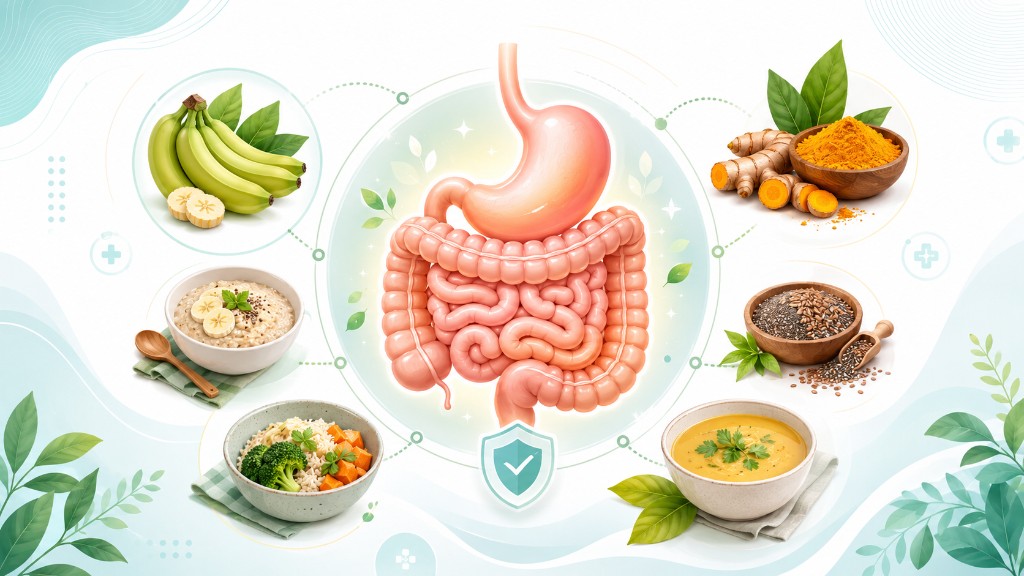
This table is a nutrition toolkit aimed at soothe · clear gas · improve transit · easy digest · ease spasm.
It does not replace clinician-directed care, but it helps the body reclaim balance.
| Food / support | Primary role | Typical use (overview) |
|---|---|---|
| Green banana (Namwa) powder | Tannins help soothe mucosa + resistant starch feeds beneficial microbes | 2 tsp + warm water before 3 meals |
| Turmeric / curcumin capsules | Anti-inflammatory support; may aid bile flow and gas comfort | 1–2 capsules right after meals (per tolerance and clinician advice) |
| Psyllium husk / basil seed (manglak) | Soluble fiber adds stool bulk; reduces residue and reverse gas pressure | Mix with a large glass of water + drink enough fluids |
| White fish / steamed chicken breast | Easy protein — less workload for the stomach | Steam / boil / braise — avoid frying |
| Mild vegetables (pumpkin, sponge gourd, winter melon) | Soft fiber; less fermentative gas than harsh raw piles | Boil or braise until soft |
| Warm water / chamomile tea | May ease smooth-muscle tension and support stress calm | Small sips through the day |
Not sure how severe your symptoms are right now?
Analyze your severity level and get personalized guidance from our Advisory team
3-step behavior checklist
1Soothe mucosa and reduce gas
- Green banana powder + curcumin per your plan
- Temporarily avoid fatty, fried, very spicy foods, coffee, and alcohol
- Leave at least 3 hours between last meal and bedtime
2Clear residual load in the bowel
- Add fiber (psyllium husk / basil seed) gradually
- Aim for about 2–2.5 L fluid/day (adjust if kidney/heart disease — ask your clinician)
- Walk lightly 10–15 minutes after meals
3Settle the mind–gut loop
- Stop doom-scrolling symptom searches that re-stress you
- Practice slow breathing or quiet sitting 10 minutes daily
- Remember: a normal test is a hopeful foundation — not the end of care
Treatment comparison: medicines · food-as-medicine · lifestyle
| Approach | Examples | Best when | Limits |
|---|---|---|---|
| Clinician-directed medicines | Antacids, alginate raft-formers, H2RAs, PPIs as indicated | Acute flares or when a clinician judges medicine necessary | Does not fully fix habits, fiber deficits, or stress loops |
| Food as medicine | Green banana, curcumin, soluble fiber, easy protein, mild vegetables | Irritated mucosa, trapped gas, sluggish transit | Needs consistency and clean sourcing; contraindications in some diseases |
| Lifestyle + mind–gut care | Trigger pause, no late meals, post-meal walk, less symptom-search loops | Chronic symptoms despite normal tests | Takes time and discipline — not overnight results |
Scientific mechanism: why “normal” still feels full
Irritated mucosa
Scope images can look calm while mucosa stays reactive to fat, coffee, and late meals.
Gas and pressure
Residue stays → gas builds → pressure pushes upward → fullness.
Hypersensitive nerves
Functional Dyspepsia amplifies symptom perception even when structure looks normal.
Mechanism summary by
Asst. Prof. Dr. Norawit Raatpiboon,
synthesized from
NIDDK (Dyspepsia)
and
GERD clinical guidance.
FAQ
Can I combine acid-reducing medicine with natural food supports?
Yes — use prescribed medicines alongside food and habit changes.
Discuss tapering only when symptoms stabilize; do not stop abruptly on your own.
After a normal endoscopy, should I still fear cancer?
A normal result is good news and sharply lowers the chance of visible serious disease at that time.
Red flags (blood, black stool, weight loss, food sticking) still need immediate care.
Long-term work is restoring balance — not nightly panic searches.
Why is acid reduction alone not enough for some people?
Because acid reducers do not fully soothe mucosa, clear gas, or normalize transit.
Many cases need food, fiber, and behavior care together.
Should I start food-as-medicine one item at a time or all at once?
Prefer one change at a time, observe 2–3 days, then add the next.
A sensitive gut usually prefers gentle layering over a same-day overhaul.
Does chamomile tea really help?
Many people use it for mild spasm ease and stress support alongside warm water sips.
It is not a cure-all, but it fits a recovery plan as a gentle adjunct.
If I do everything and still do not improve, what next?
Follow up with your clinician — medicines, co-factors, or further testing may need review.
Do not escalate drug strength yourself without advice.
When should I go to emergency care after a previously normal scope?
Vomiting blood, black stools, unexplained weight loss, food sticking, severe chest pain,
or rapidly worsening symptoms — seek care immediately.
Support this writing
If this food-as-medicine roadmap reduced fear after a “normal” endoscopy,
a coffee-sized donation helps keep free, cited explainers online in Thai and English.
Read next
Citations (E-E-A-T)
- NIDDK — Indigestion (Dyspepsia)
- NIDDK — Acid Reflux (GER & GERD)
- PubMed — ACG Clinical Guideline: GERD
- PubMed — Functional dyspepsia
- PubMed — Curcumin / turmeric GI review
- PubMed — Psyllium and bowel function
Author:
Asst. Prof. Dr. Norawit Raatpiboon
(ผศ.ดร.นรวิชญ์ ราษฎร์พิบูลย์)
Medical disclaimer
It is not individualized medical advice.
Vomiting blood, unexplained weight loss, or jet-black stools requires urgent medical care.
Combining foods/herbs with medicines should be discussed with a physician or pharmacist —
especially with chronic disease, pregnancy, or anticoagulant use.
Educational GERD / Functional Dyspepsia content for GEO/YMYL literacy only.