Gastroenterology · Sorting causes of waist and back pain
Can GERD and Panic Attacks Cause Back Pain? Possible Links, Other Causes and Warning Signs
Sort the urgent signs before reading about earlier illnesses
Go to an emergency department for these spine and nerve signs
The NHS back-pain and sciatica pages say to go to an emergency department, or call an ambulance, if any one of these is present. Do not wait for a full list, and do not wait for reflux or panic to settle first.
- Pain, numbness, weakness, or tingling in both legs, especially if it is severe or getting worse
- Numbness around the genitals or anus
- New trouble starting urine, inability to pass urine, or new loss of bladder or bowel control
- Neurological symptoms that are worsening quickly
- Back pain that started after a serious accident, such as a car crash
Call 1669 for suspected acute heart ischemia
Chest pressure, unusual breathlessness, a cold sweat, light-headedness, or a feeling of near-fainting means call 1669 now. The NHS places chest pain that comes with back pain in the group that needs an ambulance. Do not use a home checklist as the gate before the call.
A suspected kidney infection needs urgent care
Flank or back pain with fever, shivering, nausea, burning urine, cloudy urine, or blood in the urine raises the need to check the kidney and urinary tract. Do not wait until every symptom is present. The NHS says a kidney infection can lead to sepsis if it is not treated. Do not try to manage that suspicion at home.
Short answer
GERD and panic can occur along with back pain, but that does not prove the cause of waist pain. Waist pain is not a specific panic symptom. The pain is real. Call for help if both legs are numb, urine will not pass, or the chest is tight.
Location, movement, leg symptoms, and urine help a clinician choose what to examine. One pattern does not name a disease.
Occurring together is not proof of cause
A person who has reflux and panic symptoms can also have waist or back pain at the same time. A group post does not include age, the exact site, how long it has lasted, or test results. This page does not conclude that GERD or panic is the cause of that pain.
The pain is real. It is not something the person is imagining. An existing illness should not stop the search for the cause of a new symptom.
Does reflux explain waist pain?
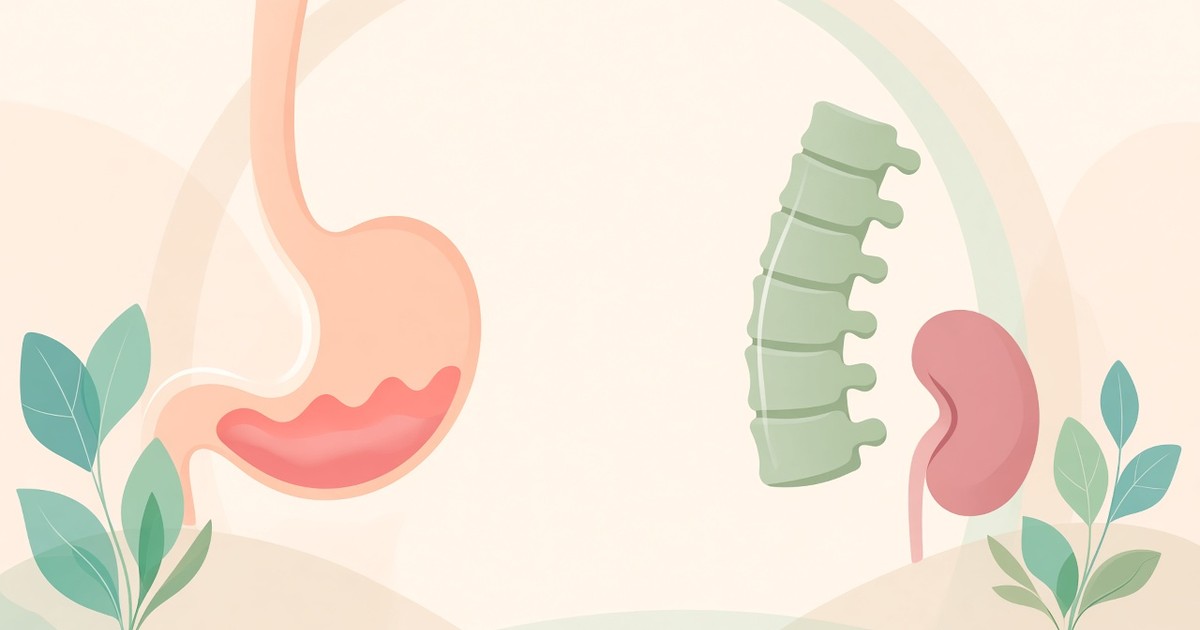
The 2022 American College of Gastroenterology guideline describes typical GERD symptoms as heartburn, a substernal burning that rises from the upper abdomen toward the neck, and regurgitation, the effortless return of stomach contents, often with a sour or bitter taste.
The extraesophageal problems named there include hoarseness, chronic cough, laryngeal symptoms, and asthma. A strong recommendation says to evaluate non-GERD causes before ascribing those problems to reflux. Waist and lower-back pain are not on that list, so a reflux label alone should not be asked to explain them. The guideline does not say that acid damages a disc.
Chest pain that cannot be separated from heart pain may still be esophageal after the heart has been assessed. The guideline then recommends endoscopy or reflux monitoring, and it does not use a medicine response as the only decider. That is a different question from lower waist pain.
Upper back, waist, and flank are not the same site
Upper back, between the shoulder blades
The NHS separates pain from the top of the back, between the shoulders, from lower-back pain, and says to see a clinician when pain comes from that upper site. Chest pain with it belongs in the 1669 box above.
Lower waist, over or beside the spine
Lower-back pain is common and often improves within a few weeks. A pulled muscle is a common cause. A disc, a nerve, or inflammatory spinal disease can also do it. A broken bone, cancer, or infection is much less common. The site alone does not choose among them.
The side, under the ribs, on one side
A deep pain in the flank is not the same as pain over the middle of the spine. Fever or a change in urine raises the need to check the kidney. It does not mean that every flank ache is a kidney disease.
Read the warning box first, then see when to visit
This button moves to the visit section. It does not find the cause of back pain, and it does not replace a call to 1669.
Panic and pain can be linked, without pain being a diagnostic symptom
The U.S. National Institute of Mental Health lists pounding heart, sweating, trembling, trouble breathing, chest pain, stomach pain or nausea, tingly or numb hands, and weakness or dizziness during a panic attack. Waist pain is not on that list, so it is not a specific symptom used to diagnose panic disorder.
Anxiety may relate to muscle tension, and to a stronger sense of pain, in some people. That link cannot confirm the cause of this person’s back pain. The pain is still real.
One panic attack is not panic disorder. Diagnosis needs repeated unexpected attacks plus at least one month of worry or a change in behavior. The clinician also checks that another physical problem is not causing the symptoms.
Worry can make pain feel sharper without erasing other causes
During a panic attack the body sounds an alarm when no clear danger is in front of the person. Some people then watch the pain more closely, fear that it is serious, and breathe faster or tighten the muscles again. That loop can happen. It does not mean muscle, bone, nerve, or kidney disease is absent.
Explaining the pain by worry alone, before the site has been examined, is a risk in how symptoms are read. It is not a finding that a particular clinician made a wrong diagnosis.
What a pain pattern suggests checking
This table is a map for a clinical visit. No row names a disease from one feature.
| What can be noticed | What it suggests checking | What this feature cannot do |
|---|---|---|
| Pain with bending, twisting, long sitting, or lifting | Muscle and spine | It does not name a strain or a disc |
| Pain down one leg with numbness or weakness | A nerve from the lower back | Back pain alone is usually not sciatica, and it is not an order for surgery |
| Flank pain with fever, shivering, or a change in urine | Kidney and urinary tract, urgently if infection is suspected | It does not mean every waist pain is the kidney, and the full list is not required first |
| Heartburn and regurgitation at a different time from the waist pain | Reflux care for those symptoms, kept separate from the back | It does not prove that acid caused the waist pain |
| A pounding heart, sweating, and hard breathing, then sharper pain | Panic symptoms that need their own care, plus a look at the pain | It does not mean the pain is imagined |
Muscle, spine, and nerve
The NHS says the cause of back pain is often unclear and that it often improves. A muscle strain is common. See a clinician if it has not improved after a few weeks of home care, if it stops daily activities, if weight falls without trying, if there is a lump or a change in shape, if it is worse at night, or if it is worse with sneezing, coughing, or passing stool.
Sciatica is irritation or compression of the nerve that runs from the lower back to the foot. Symptoms usually affect the buttock and the back of one leg, often including the foot. Pain, tingling, numbness, or weakness can occur, and the leg pain is often worse than the back pain. A slipped disc is the most common cause. Narrowing of the spinal canal, a slipped vertebra, and injury are other causes. Back pain alone is usually not sciatica.
Without emergency signs, the NHS says to stay active and not to stay in bed for long periods. Stop a movement that makes the pain worse and see a clinician. Ask a clinician or pharmacist before a pain medicine, especially with reflux or a possible kidney problem, because some anti-inflammatory drugs are not suitable for everyone. This page gives no dose.
When the kidney and urine belong in the differential
The NHS kidney-infection page includes lower-back or side pain, fever, nausea, aching muscles, pain when passing urine, needing to pass urine more often, and dark or cloudy urine. Seek urgent care if a kidney infection is suspected and there is a high fever, shivering, pain in the lower abdomen or back under the ribs, blood in the urine, vomiting, or no urine all day, and also in pregnancy. Confusion, drowsiness, or trouble speaking means call an ambulance.
NIDDK describes kidney-stone pain as sharp pain in the back, side, lower abdomen, or groin. It may come in waves, with blood in the urine, pain while urinating, or only a small amount of urine, plus nausea, vomiting, fever, or chills. See a clinician soon if that cluster is present. Those symptoms can be a stone or another condition that needs a look.
A lingering waist ache without fever and with ordinary urine is not labeled a kidney problem by those two pages.
Symptoms that may involve the heart
The ACG guideline says GERD chest pain cannot be separated from cardiac pain by the description alone. The heart is assessed first. Reflux testing comes after that. Chest pressure, breathlessness, a cold sweat, or near-fainting means call 1669 before opening a comparison page.
When to see a clinician, and what to write down
See a clinician if the pain is not improving after a few weeks of staying active, if it is severe, if it is worsening, or if daily tasks have stopped. Go sooner with fever, flank pain, or a change in urine. Use the emergency box above when it fits.
- Whether the pain is upper back, lower waist, or flank, and whether it is on one side or both
- Whether it appears only during panic or also when worry is quiet
- Whether bending, twisting, long sitting, or lifting changes it
- Whether pain travels down a leg, with numbness, weakness, fever, or a change in urine
- Medicines already in use, including anti-inflammatory drugs. Do not start, raise, lower, or stop them before the visit
What a clinician may check, when there is a reason
The visit starts with the site, leg strength, feeling, and walking. Fever or a change in urine is a reason for a urine test. Pictures are not automatic for everyone who asks whether reflux is related to back pain. The NHS page does not make an X-ray or MRI the first step for ordinary back pain without danger signs.
Endoscopy or reflux monitoring belongs to esophageal symptoms, after a heart assessment when there is chest pain. They are not the standard test for waist pain.
How reflux is cared for, without using that plan as the back-pain answer
For heartburn and regurgitation without alarm symptoms, the ACG guideline recommends that a clinician consider an 8-week once-daily proton pump inhibitor taken before a meal. That trial is not a treatment for waist pain, and it is not an instruction to start a medicine alone. If classic symptoms respond, the guideline suggests trying to stop the medicine under care. Weight loss when weight is high, avoiding meals within 2 to 3 hours of bedtime, avoiding tobacco, and avoiding personal trigger foods are suggestions in the same guideline. They are separate from naming the cause of back pain.
How panic symptoms are cared for
NIMH describes cognitive behavioral therapy as a research-supported psychotherapy for panic disorder. A clinician may use an SSRI or SNRI, and in some situations a beta-blocker or a short course of a benzodiazepine. The choice belongs to the clinician. This page gives no dose and no instruction to start a medicine. Sleep, movement, and meals can help, and NIMH says they do not replace treatment.
Care for the back follows the cause, not the older label
Without danger signs, stay close to usual activity, walk, and do not stay in bed for long periods. A wrapped cold or warm pack is an NHS option for ordinary back pain. Stop if the pain gets worse. Physiotherapy, or a therapy that helps a person cope with pain, may be offered if the pain is not better after a few weeks. Surgery is a later option for a condition that warrants it after other care has not helped. It does not start from a group post.
Nothing read for this page promises that back pain will settle once reflux or panic improves.
When to ask for the explanation to be reviewed
Ask for another look when a new symptom is explained only by panic or reflux before location, the legs, fever, or urine have been considered, or when the pain is worsening while waiting. That is a review of the information. It is not a statement that the earlier clinician was wrong.
Different questions these links answer
- Can GERD trigger panic attacks? covers the link between the two. It does not sort waist pain.
- Chest pressure radiating to the back is about chest pain, not the lower waist.
- Sorting burning from pressure that may be the heart is for when the 1669 box does not already fit.
- Low back pain so bad you cannot lie flat is about sleep position and back danger signs.
- Big-toe numbness and an L5–S1 disc is for numbness into the foot, not this post.
Common questions
Can GERD cause waist pain?
The ACG guideline does not list waist pain as a GERD symptom. Typical symptoms are heartburn and regurgitation. Occurring together does not prove the cause.
Can panic attacks cause back pain?
Waist pain is not a specific symptom used to diagnose panic disorder. Anxiety may relate to muscle tension and to how strongly some people feel pain, but it cannot confirm the cause in this case. The pain is real.
Does back pain alone mean a trapped nerve?
No. The NHS says back pain alone is usually not sciatica. Pain down one leg with numbness raises the need to assess the nerve. One pattern does not name the disease.
Is every episode of waist pain from the kidney?
No. Flank pain with fever, shivering, or a change in urine raises the need to check the kidney and urinary tract. If a kidney infection is suspected, seek care urgently. Do not wait for every symptom.
Must every kidney-infection symptom be present first?
No. The NHS says a kidney infection can lead to sepsis if it is not treated. Seek an urgent assessment when it is suspected.
Will back pain always settle once panic or GERD improves?
There is no such promise. The earlier conditions may improve while back pain has another cause. Care follows what the examination finds.
Does the button on this page find the cause of back pain?
No. The button moves to the section on when to see a clinician. This page does not use a reflux or mental-health questionnaire to name the cause of back pain.
When should an earlier explanation be reviewed?
When a new symptom is explained only by panic or GERD before location, the legs, fever, or urine have been considered. An existing illness should not stop the search for the cause of a new symptom.
How the author explains the mechanism
Asst. Prof. Dr. Norawit Raatpiboon separates three layers. Acid at the lower esophagus produces heartburn and regurgitation, which is not the waist. During a panic attack the brain can read body signals as danger, so some people feel pain more sharply while the pain is still in the body. Muscle, disc, nerve, and kidney can each generate pain on their own.
Hallyburton in 2022 quotes Jones and colleagues in 2008: diagnostic overshadowing is the process by which physical symptoms are misattributed to mental illness. That is a risk in assessment. It is not a statement that it happened to a particular poster, and it is not a charge against a clinician. An existing illness should not stop the search for the cause of a new symptom.
Sources read for this page
- Katz PO, Dunbar KB, Schnoll-Sussman FH, Greer KB, Yadlapati R, Spechler SJ. ACG Clinical Guideline: Guidelines for the Diagnosis and Management of Gastroesophageal Reflux Disease. Am J Gastroenterol. 2022. PMID 34807007. PMC8754510
- NHS. Back pain. Page last reviewed 5 March 2026. nhs.uk/conditions/back-pain
- NHS. Sciatica. nhs.uk/conditions/sciatica
- National Institute of Mental Health. Panic Disorder: When Fear Overwhelms. nimh.nih.gov
- NHS. Kidney infection. Page last reviewed 13 February 2025. nhs.uk/conditions/kidney-infection
- National Institute of Diabetes and Digestive and Kidney Diseases. Symptoms and causes of kidney stones. Last reviewed May 2017. niddk.nih.gov
- Hallyburton A. Diagnostic overshadowing: an evolutionary concept analysis. Int J Ment Health Nurs. 2022;31(6):1360-1372. PMC9796883, quoting Jones and colleagues, 2008.
Limit of this page
This page is education. It is not an examination, a diagnosis, or a prescription. A group post does not contain enough detail to name the cause of waist pain. If the emergency box fits, contact emergency services before reading on.