Home · English · Cardiology
Heart · coffee, caffeine, and medicines
Coffee and Arrhythmia Medications: Interactions, Safe Timing and Caffeine Precautions
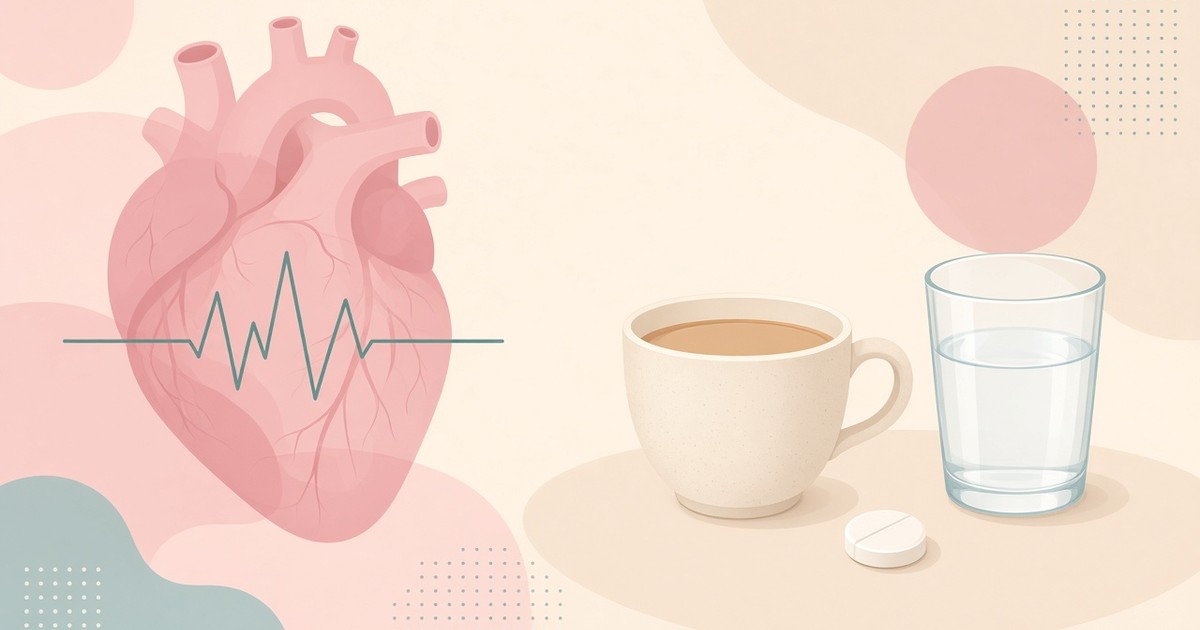
This page is general education. It does not diagnose a social-media post, and it does not tell a reader to delay, stop, or increase a heart medicine.
Symptoms that need an emergency call
Chest pain, severe breathlessness, near-fainting, loss of consciousness, or palpitations together with near-fainting come before any question about coffee or dose timing. In Thailand, call 1669.
A short spell of palpitations without those features is not automatically that emergency call. It is also not proof that the rhythm is normal.
Short answer
An arrhythmia does not mean every person must stop coffee. The 2023 atrial fibrillation guideline does not order caffeine abstention to prevent recurrence, yet a clear personal trigger belongs with the care team. Checked labels set no shared coffee-hour rule, and that silence is not a safety promise.
Can a person with an arrhythmia drink coffee?
The answer depends on the rhythm type, what happens after coffee, and the medicine list. There is no single rule for every person.
If the care team has already said to avoid caffeine, follow that plan. This page does not invite a coffee trial to prove a trigger when the rhythm is severe or has not been assessed.
Felt palpitations are one layer. A rhythm recorded on an electrocardiogram, or on monitoring when that test is indicated, is another. A caffeine–medicine interaction is a third.
AF, PVC, PAC, and SVT do not share one evidence base
Atrial fibrillation
Section 5.2.5 of the 2023 ACC/AHA/ACCP/HRS guideline gives Class 3: No Benefit to recommending caffeine abstention in order to prevent atrial fibrillation episodes. Abstention may reduce symptoms in a person who reports that caffeine triggers or worsens them. The guideline does not support starting or increasing caffeine to prevent atrial fibrillation.
Alcohol is a different recommendation. The same guideline advises people who want rhythm control to reduce or stop alcohol. The coffee statement cannot be copied onto every drink.
PVC, PAC, and SVT
The 2023 CRAVE trial studied 100 healthy adults, mean age 39. Premature atrial contractions were 58 versus 53 per day, rate ratio 1.09, 95% confidence interval 0.98 to 1.20, P 0.10. Premature ventricular contractions were higher on coffee days, rate ratio 1.51, 95% confidence interval 1.18 to 1.94. Nonsustained supraventricular and ventricular runs were not clearly different.
The authors note that the trial was not blinded and that the results should not be extended to people with frequent premature beats. It was not a trial in people with atrial fibrillation.
The page on a skipped beat then a thump and the page on atrial fibrillation and stroke prevention answer different questions from coffee taken with medicines.
Check the medicine name before deciding about coffee
The generic name shows whether the question is absorption, meals, or a caffeine effect. Do not guess from tablet color, and do not delay, stop, or increase a dose in order to drink coffee.
How coffee can be followed by palpitations
Caffeine is a stimulant and can make the heartbeat easier to notice. The 2023 atrial fibrillation guideline separates that feeling from confirmed atrial fibrillation. Caffeine may worsen symptoms, cause a similar sensation, or increase awareness of the rhythm.
Swallowing a tablet with coffee is a separate problem. The drink may reduce absorption of some medicines, or caffeine may change the level or the effect of a medicine. A time gap helps only the absorption problem a label actually describes. It does not cancel stimulation, and it does not fix every enzyme interaction.
Evidence table: coffee and rhythm
| Source | Who was studied | What it found | Limit |
|---|---|---|---|
| ACC/AHA/ACCP/HRS 2023, section 5.2.5 | People with atrial fibrillation | Class 3: No Benefit for caffeine abstention to prevent episodes. It may help symptoms if the person reports caffeine as a trigger. Do not start or increase caffeine for prevention. | Not a substitute for PVC, PAC, or SVT evidence. Energy drinks are not ordinary coffee. |
| CRAVE 2023 | 100 healthy adults, mean age 39 | Premature atrial contractions not significant, rate ratio 1.09. Premature ventricular contractions rate ratio 1.51. | Not blinded. Do not extend it to frequent ectopy or to atrial fibrillation. |
| JCS/JHRS 2024 | Narrative text in the atrial fibrillation section | No new recommendation table for coffee of the kind written for alcohol. It recalls a 2020 statement to limit caffeine when supraventricular extrasystoles affect quality of life, and it says newer reports do not show that usual caffeine raises atrial fibrillation risk. | A different statement from the 2023 atrial fibrillation class and from CRAVE. |
| ESC 2024 | Overview page opened for this article | No caffeine recommendation was visible on that page, so no ESC class is stated here. | The full chapter was not opened for a caffeine sentence. |
Coffee with rate and rhythm medicines
These medicines are not all forbidden with coffee, and they are not all safe with coffee. An hour gap is written only when a checked document states one.
| Medicine | Coffee or food in the opened document | What matters more than a coffee rule | What can be said |
|---|---|---|---|
| Metoprolol | The NHS common-questions page says you can eat and drink normally, aside from alcohol caution if dizzy. No coffee-hour gap was found. | Low blood pressure and dizziness when the dose is new or increased. | No hour rule was found. “Eat and drink normally” is not a promise that caffeine is safe for every person. |
| Bisoprolol | The NHS page says you can eat as normal. No coffee-hour gap was found. | Alcohol may add to low blood pressure, and fasting is not advised. | Same limit as metoprolol. Do not move the dose yourself. |
| Diltiazem | The NHS common-questions page says there is no food or drink that must be avoided. | Other medicines that lower blood pressure or pulse, some antibiotics and antifungals, and St John’s wort. | No hour rule was found. |
| Verapamil | The NHS how-to-take page does not set a coffee-hour gap. | Grapefruit is forbidden. Interactions include digoxin, flecainide, and dabigatran. | The drink the page names is grapefruit, not coffee. |
| Digoxin | The NHS page says you can eat normally. | Kidney and electrolyte checks, and medicines such as amiodarone, verapamil, and diltiazem. | No hour rule was found. Do not stop the medicine because of palpitations. |
| Sotalol | The NHS page says you can eat and drink normally. | The atrial fibrillation guideline calls for QT, kidney, potassium, and magnesium monitoring. No statement was found that caffeine prolongs QT. | No caffeine-hour rule was found, and none is invented here. |
| Amiodarone | The DailyMed label that was checked does not contain the words coffee or caffeine. Food increases absorption. In 30 healthy subjects a high-fat meal increased AUC about 2.3-fold and peak concentration about 3.8-fold versus fasting. The label says to take the tablets consistently with regard to meals. | Avoid grapefruit juice and St John’s wort. Grapefruit juice raised AUC by 50% and peak concentration by 84% in healthy volunteers. The main warnings are lung, liver, and worsening rhythm. The label says amiodarone inhibits CYP1A2, but the interaction table does not name caffeine. | No coffee-hour requirement was found. Meal consistency is not a coffee rule and is not permission to swallow the tablet with coffee. |
| Flecainide | The DailyMed label says food or antacid does not affect absorption. Milk may inhibit absorption in infants. The words coffee and caffeine do not appear. | The indication is for people without structural heart disease. In CAST, after myocardial infarction with asymptomatic ventricular arrhythmias, death or cardiac arrest occurred in 16 of 315 people on flecainide versus 7 of 309 on the matched comparison. Those figures are not about coffee. | No coffee-hour requirement was found. The milk sentence is about infants. Silence is not a safety promise. |
Do not change the clock time, the meal pattern, or the dose of amiodarone or flecainide on your own. The meal sentence on the amiodarone label means staying consistent with the plan already set. It is not a new coffee schedule.
Coffee and anticoagulants
The NHS anticoagulant considerations page, reviewed 9 September 2024, does not list coffee or caffeine among the warfarin foods. It says to keep vitamin K intake steady, not to drink cranberry juice or grapefruit juice, and to limit alcohol.
The same page says those restrictions do not usually apply to apixaban, dabigatran, edoxaban, or rivaroxaban, and that the clinic should still be asked. Absence of a coffee rule does not mean every anticoagulant interacts with caffeine, and it does not mean other foods or medicines can be changed alone. Interactions between an anticoagulant and amiodarone, verapamil, or diltiazem are drug–drug questions for the pharmacist who can see the real list.
Medicines for which caffeine can change level or effect
This table is secondary so it does not crowd out the rhythm question. A time gap is not the answer for every row.
| Medicine | What the document says | Does a time gap fix it? |
|---|---|---|
| Clozapine | The label lists caffeine as a moderate or weak CYP1A2 inhibitor. Monitor closely. The prescriber may consider a dose reduction if needed. | No hour rule was found. Skipping a cup does not replace a prescriber’s dose decision. |
| Ciprofloxacin | The label says the antibiotic may increase the effects of caffeine. Clearance falls and caffeine may accumulate. The label also asks about an irregular heartbeat and QT prolongation before treatment. | No hour count was found that restores caffeine handling. Milk in coffee is a separate problem because metal cations can reduce absorption of this antibiotic. |
| Diazepam | The NHS page says drinks that contain caffeine can sometimes reduce the effect. Swallow tablets with water. Do not drink alcohol or grapefruit juice. | No minute count was found that brings the effect back. Do not take two doses to make up a missed one. |
| Pseudoephedrine | The NHS page says you can eat and drink normally, including alcohol. Palpitations can be a serious effect, and the medicine is not suitable for everyone with high blood pressure or heart disease. | No coffee-separation rule was found. That sentence is not copied onto phenylephrine, because a phenylephrine monograph was not opened. |
Medicines whose absorption coffee can reduce
These intervals apply only where the document writes them. They are not a one-hour rule for the heart medicines above.
- Levothyroxine, on the NHS page, is swallowed with water on an empty stomach, about 30 to 60 minutes before the first meal, any caffeinated drink, or another medicine. Do not take two doses together.
- Ferrous sulfate, on the NHS how-to-take page, is not taken with tea, coffee, eggs, or dairy, and a 2-hour gap is stated. Do not take two doses to catch up. That coffee gap was not confirmed for every iron salt.
- Alendronic acid is taken with plain tap water only, not tea, coffee, juice, or milk, usually about 30 minutes before breakfast, while sitting or standing. A missed weekly tablet is not doubled on the same day.
Decaffeinated coffee was not shown to be automatically acceptable with levothyroxine tablets, because the review that was used did not include a separate decaf arm.
Black coffee, coffee with milk, decaf, and energy drinks
| Drink | What can be said | What cannot be said |
|---|---|---|
| Ordinary black coffee | This is the drink the atrial fibrillation guideline discusses at usual amounts. | It does not mean every person with an arrhythmia can drink it. |
| Coffee with milk | Milk is an absorption problem for ferrous sulfate and alendronic acid on the NHS pages. | The flecainide milk sentence is about infants, not an adult ban on lattes, and it is not a promise that a latte is safe. |
| Decaffeinated coffee | It contains less caffeine than ordinary coffee. | CRAVE had no separate decaf arm, and decaf does not remove the meal effect on amiodarone. |
| Energy drinks or concentrated caffeine | The atrial fibrillation guideline separates high caffeine exposure and energy drinks from ordinary coffee. | They should not be treated as equivalent to a usual cup. |
Stop completely, or reduce first?
A person without symptoms linked to coffee, and without an instruction to avoid caffeine, does not have to stop entirely on the strength of the 2023 atrial fibrillation statement. Clear palpitations, chest tightness, or a change in rhythm after coffee should be discussed with the care team as a reason to reduce or avoid caffeine. Do not start a self-trial when symptoms are severe or the rhythm type is still unknown.
Sudden stopping followed by exhaustion is a different question. It is covered in the page on caffeine withdrawal after quitting coffee for a fast heartbeat.
How to log palpitations and coffee
Note the time, whether the cup was black, with milk, or decaffeinated, when the feeling started and stopped, whether there was chest pain, breathlessness, or near-fainting, which morning medicines were taken, and whether an electrocardiogram was recorded during the symptom.
The log supports a clinical conversation. It does not diagnose atrial fibrillation, premature beats, or supraventricular tachycardia by itself. The page on palpitations after short sleep makes the same separation between a feeling and a recorded rhythm.
A safer way to take morning medicines
Swallow each tablet with water, as that label says. Heart medicines whose NHS pages say eating and drinking can stay normal do not gain a new one-hour coffee rule on this page.
Levothyroxine, ferrous sulfate, and alendronic acid keep the intervals in the absorption section. Those intervals are not extended to rhythm medicines.
If a dose was already swallowed with coffee
Do not take another tablet, stop the medicine, or raise the dose to compensate. An extra dose can be dangerous for several medicines, including levothyroxine, ferrous sulfate, weekly alendronic acid, and diazepam, on the NHS pages that were used.
If chest pain, severe breathlessness, near-fainting, or loss of consciousness follows, call emergency services. Without those symptoms, ask a pharmacist or the care team the same day, with the medicine names and the time of the coffee.
When to see a clinician or a pharmacist
- The rhythm type is still unknown: atrial fibrillation, premature beats, supraventricular tachycardia, or something else.
- Coffee is followed by clear palpitations, chest tightness, or a change from the usual rhythm.
- There is already an instruction to avoid caffeine.
- Amiodarone, flecainide, sotalol, or another QT-monitored medicine is in use and a drink or another medicine may change.
- Warfarin or another anticoagulant is in use and food, medicine, or a supplement may change.
- Clozapine or ciprofloxacin is taken regularly with caffeine.
- During amiodarone there is cough, breathlessness, yellow eyes or skin, dark urine, vision change, or a new rhythm symptom.
How to check the label and ask a pharmacist
- Read the generic name. Do not guess from color or from a packet that is only partly visible.
- Separate three questions: does the document mention coffee or caffeine, is the issue absorption or effect, and is another drink restricted more clearly?
- If no hour count is written, say that no such requirement was found. Do not convert that sentence into “safe together for everyone.”
- Photograph the label, cover name, address, and identification numbers, and ask a pharmacist to review every item.
- Until that answer exists, swallow the dose with water as the label says.
Questions readers ask
Must everyone with an arrhythmia stop coffee?
No. The 2023 atrial fibrillation guideline does not order caffeine abstention to prevent recurrence. A person with clear symptoms after coffee should ask the care team about cutting down or avoiding it. Do not start or increase coffee in the hope of prevention.
Do palpitations after coffee mean atrial fibrillation has recurred?
A feeling alone cannot answer that. Felt palpitations and a rhythm recorded on an electrocardiogram are different layers. The arrhythmia type and indicated monitoring still matter.
Can atrial fibrillation evidence stand in for PVC, PAC, or SVT?
No. In healthy adults the CRAVE trial did not find a significant rise in premature atrial contractions, but premature ventricular contractions increased. That trial should not be extended to people with atrial fibrillation or to people who already have frequent early beats.
How many hours should amiodarone be separated from coffee?
The DailyMed label that was checked states no coffee-hour gap. It says to take the tablets consistently with regard to meals and to avoid grapefruit juice. Silence about coffee is not a promise of safety for every person.
Can flecainide be taken with food, and must coffee be separated?
The label says food or antacid does not affect absorption, and it states no coffee-hour gap. The milk sentence is about infants, not an adult latte rule. That silence does not promise safety for every person.
Does every anticoagulant interact with coffee?
The NHS anticoagulant page that was opened does not list coffee for warfarin. It lists steady vitamin K, no cranberry juice, no grapefruit juice, and an alcohol limit. It says those food rules do not usually apply to apixaban, dabigatran, edoxaban, or rivaroxaban.
If a dose was swallowed with coffee, should another tablet be taken?
Do not repeat, stop, or increase the dose. A time gap helps only when coffee reduces absorption of that medicine. It does not remove caffeine stimulation, and it does not fix every metabolic interaction.
Which symptoms should lead to an emergency call?
Chest pain, severe breathlessness, near-fainting, loss of consciousness, or palpitations together with near-fainting need emergency help, 1669 in Thailand. A short run of palpitations without those features is not automatically that call.
How this page separates the mechanisms
Asst. Prof. Dr. Norawit Raatpiboon separates three layers. Caffeine may increase awareness of the heartbeat or provoke symptoms without an electrocardiogram showing atrial fibrillation every time. Population evidence about atrial fibrillation does not measure one person’s premature ventricular contractions, and CRAVE was not done in people with atrial fibrillation. A liquid that reduces absorption is not the same problem as caffeine changing a drug level through an enzyme.
The amiodarone label states that the drug is a substrate of CYP3A and CYP2C8 and that it inhibits CYP1A2 among other enzymes. The interaction table that was checked does not name caffeine, so the page stops at “no coffee-hour requirement was found” instead of inventing an interval. Grapefruit juice has numbers on the label, so it is the drink that can be stated more clearly. The flecainide document speaks about food and absorption, not about caffeine.
References
- 2023 ACC/AHA/ACCP/HRS Guideline for the Diagnosis and Management of Atrial Fibrillation
- Marcus GM, et al. Acute Effects of Coffee Consumption on Health. N Engl J Med. 2023. DOI 10.1056/NEJMoa2204737
- JCS/JHRS 2024 Guideline Focused Update on Management of Cardiac Arrhythmias
- ESC 2024 atrial fibrillation guideline overview page opened for this article
- DailyMed. Amiodarone hydrochloride tablets
- DailyMed. Flecainide acetate tablets
- NHS. Considerations for anticoagulant medicines. Reviewed 9 September 2024
- NHS. Common questions about digoxin
- NHS. Common questions about diltiazem
- NHS. Levothyroxine
- NHS. How and when to take ferrous sulfate
- NHS. How and when to take alendronic acid
Medical disclaimer
This is education based on documents opened while the page was prepared. It does not read the visitor’s electrocardiogram and does not replace the treating clinician or pharmacist. Do not start, stop, delay, or increase a heart medicine in order to drink coffee. If a symptom in the emergency box is present, contact emergency services first.